UAE to Qatar Supply Chain
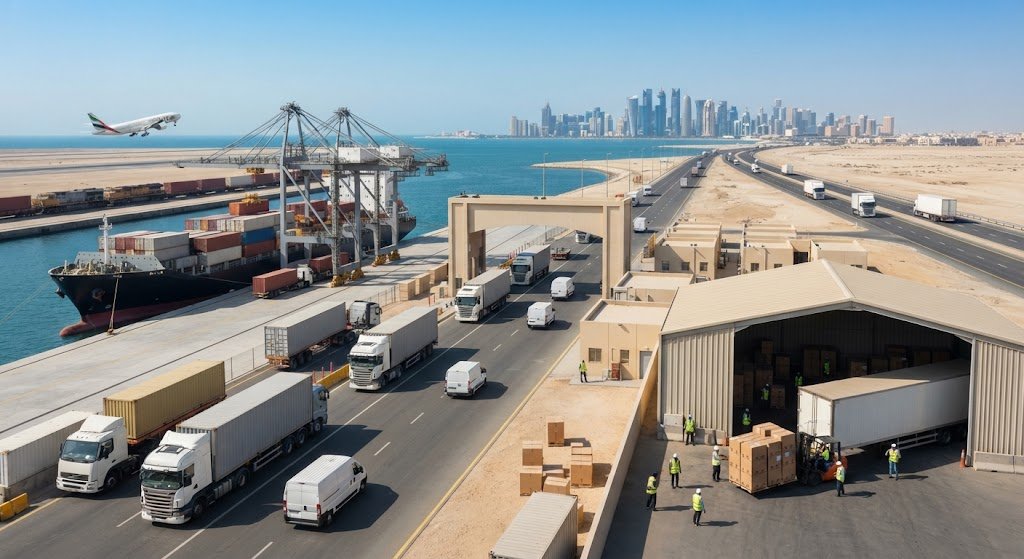
The UAE to Qatar supply chain connects businesses, suppliers, manufacturers, retailers, and distributors across two important Gulf markets. Companies regularly move commercial products, machinery, equipment, retail inventory, construction materials, spare parts, and other cargo between the UAE and Qatar. A reliable supply chain involves more than transportation. It can include cargo pickup, warehousing, export documentation, customs coordination, freight transportation, destination clearance, inventory management, and final delivery. Businesses can use different transportation methods depending on shipment size, cargo type, urgency, and budget. These options include road freight, sea freight, air freight, and multimodal transportation. What Is the UAE to Qatar Supply Chain? The UAE to Qatar supply chain is the complete process used to move goods from suppliers or warehouses in the UAE to businesses and customers in Qatar. A typical supply chain can include: Supplier or warehouse pickup Cargo inspection and packing Inventory preparation Export documentation Transportation to the departure point Cross-border or port transportation Qatar customs clearance Inland transportation Warehouse delivery Final distribution Businesses can arrange these stages separately or use an integrated logistics provider to coordinate the complete shipment. Main UAE Origins for Qatar Cargo Cargo destined for Qatar can originate from several UAE logistics hubs. Dubai Dubai is an important commercial and distribution center for UAE-to-Qatar shipments. Businesses can arrange cargo pickup from warehouses, industrial areas, free zones, and commercial locations throughout Dubai. Abu Dhabi Abu Dhabi provides access to industrial, energy, construction, and commercial supply chains. Cargo can be collected from Abu Dhabi and transported through suitable road, sea, or multimodal routes. Sharjah Sharjah is also an important logistics center for commercial cargo. Current carrier arrangements include a Sharjah-to-Khor Fakkan trucking leg as part of landbridge solutions serving Doha and other Upper Gulf destinations. UAE to Qatar Road Freight Road freight is an important option for businesses requiring regional cargo transportation. Depending on the current operating arrangement, road freight can be used for: Full truckload cargo Less than truckload cargo Palletized shipments Commercial goods Machinery Retail inventory Construction materials General cargo A road freight shipment can include UAE pickup, documentation, border procedures, Qatar customs coordination, and final delivery. For businesses with regular GCC distribution requirements, scheduled trucking can also help maintain a more consistent supply chain. UAE to Qatar Sea Freight Sea freight can be useful for larger shipments that do not require the speed of air transportation. Containerized cargo can be handled through UAE maritime gateways and connected with Qatar’s port and inland logistics network. Sea freight may be suitable for: Full containers Consolidated cargo Heavy machinery Industrial materials Large retail shipments Construction supplies Non-urgent commercial goods Current regional carrier arrangements have also used Khor Fakkan and other UAE gateways with landbridge and feeder connections to Qatar, depending on cargo type and operational availability. UAE to Qatar Air Freight Air freight is generally selected when speed is a major priority. It can be suitable for: Urgent spare parts Electronics Documents Samples High-value products Medical or critical supplies where permitted Time-sensitive inventory Although air freight usually costs more than sea or road transportation, it can reduce transportation time for suitable shipments. FTL and LTL Freight to Qatar Full Truckload FTL (Full Truckload) means the shipment uses a dedicated truck. FTL can be suitable for: Large shipments Heavy cargo Regular commercial loads Cargo requiring dedicated transportation Businesses with fixed delivery schedules Less Than Truckload LTL (Less Than Truckload) is useful for smaller shipments that do not require a complete truck. Several compatible shipments can share transportation capacity, which can provide a practical option for businesses shipping smaller quantities. The correct option depends on cargo volume, weight, dimensions, delivery location, and required transit time. UAE to Qatar Door-to-Door Supply Chain A door-to-door service can simplify the complete supply chain. The logistics provider can coordinate: UAE Warehouse → Pickup → Export Documentation → Freight Transportation → Qatar Customs → Inland Delivery → Final Destination This approach can be useful for companies that do not want to coordinate different transport providers for each stage. Door-to-door services may include: Warehouse pickup Cargo loading Export documentation Freight booking Border or port coordination Customs clearance Final-mile transportation Delivery confirmation Customs and Documentation Documentation is an important part of the UAE to Qatar supply chain. Depending on the cargo and shipping method, documents may include: Commercial invoice Packing list Certificate of origin Bill of lading Transport documents Customs declarations Import documentation Product-specific permits where required Cargo descriptions, quantities, weights, values, and consignee information should be accurate. Special or regulated cargo may require additional approvals and documentation. For dangerous goods, carriers can require documents such as a Dangerous Goods Declaration, Safety Data Sheet, container packing certificate, and shipping-line approval. Warehouse and Inventory Management An effective UAE to Qatar supply chain can also include warehouse and inventory services. A business may store products in a UAE warehouse before sending them to Qatar according to demand. Warehouse services can include: Receiving Storage Inventory tracking Barcode management Picking Packing Palletization Cross-docking Order preparation Dispatch coordination This approach can help businesses maintain inventory availability without shipping every product immediately. Inventory Replenishment From UAE to Qatar Companies selling products in Qatar can use UAE-based inventory hubs to support regular replenishment. For example, a business may: Import products into the UAE Store inventory in a warehouse Monitor Qatar stock levels Prepare replenishment orders Consolidate shipments Transport cargo to Qatar Clear the shipment Deliver to a Qatar warehouse This model can be useful for retailers, distributors, e-commerce businesses, and companies serving multiple GCC markets. Cross-Docking for UAE to Qatar Cargo Cross-docking can reduce the need for long-term storage. Instead of storing goods for an extended period, cargo arrives at a logistics facility, is sorted or consolidated, and then moves toward its destination. This can be useful for: Fast-moving products Retail replenishment Time-sensitive inventory Consolidated shipments Regular distribution schedules The suitability of cross-docking depends on shipment timing, warehouse capability, and delivery requirements. Cost Factors for UAE to Qatar Supply Chain There is no single fixed price for UAE-to-Qatar logistics. The total cost