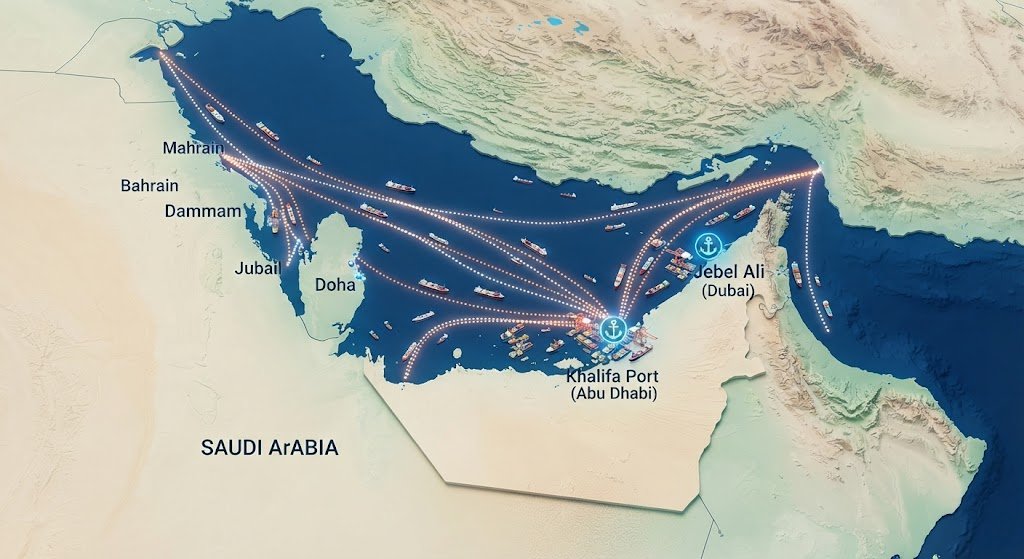
UAE to Gulf Sea Freight Routes
Businesses across the Gulf regularly move commercial goods between the UAE and other GCC markets. As a result, UAE to Gulf sea freight routes play an important role in regional supply chains.
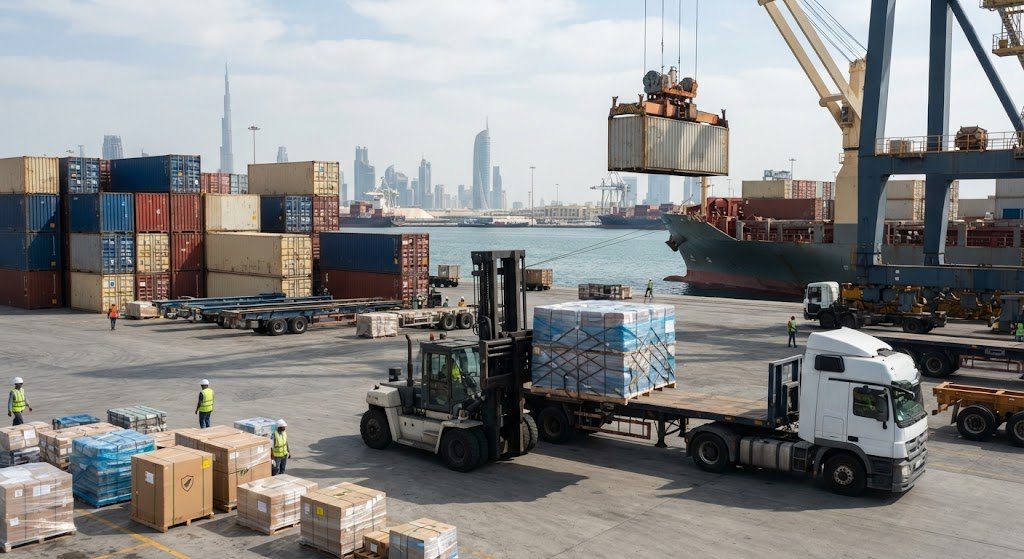
Sea freight can be a practical choice for businesses moving large, heavy, or non-urgent shipments. Depending on the destination and current carrier operations, cargo can move through major UAE ports such as Jebel Ali, Khor Fakkan, Fujairah, Khalifa Port, and other regional gateways. Current regional shipping networks also use combinations of sea freight and landbridge transportation to maintain Gulf connectivity when direct maritime routes are affected.
Main UAE to Gulf Sea Freight Routes
The UAE has several major ports that connect businesses with markets across the Arabian Gulf.
Important UAE gateways include:
- Jebel Ali Port
- Khalifa Port
- Khor Fakkan Port
- Fujairah Port
- Sharjah Ports
Sharjah Ports, for example, operates facilities on both the Arabian Gulf and UAE east coast and identifies Khor Fakkan as an important container transshipment hub.
The best port depends on the destination, shipping line, cargo type, vessel schedule, and current operational conditions.
UAE to Saudi Arabia Sea Freight
Saudi Arabia is one of the most important Gulf markets for UAE exporters.
Sea freight can connect UAE cargo with Saudi ports such as:
- Dammam
- Jubail
- Jeddah
- King Abdullah Port
For shipments destined for eastern Saudi Arabia, Gulf and Arabian Sea routing options can be considered. For western Saudi Arabia, Jeddah and King Abdullah Port can provide access to the Red Sea side of the Kingdom.
Current carrier networks also use multimodal landbridge solutions when direct Gulf routing is restricted or operationally unsuitable.
UAE to Bahrain Sea Freight Route
Bahrain is another important destination for UAE commercial cargo.
A sea freight shipment can be planned toward Khalifa Bin Salman Port in Bahrain, depending on available carrier schedules and cargo requirements.
Some regional services have historically connected UAE ports with Bahrain through Arabian Gulf feeder networks. For example, APL’s Jebel Ali–Middle East Express lists Bahrain Khalifa Bin Salman Port within its regional service network.
For urgent or time-sensitive cargo, customers should confirm the current vessel schedule before booking because maritime schedules can change.
UAE to Qatar Sea Freight Route
Qatar is an important destination for UAE exporters and distributors.
The main commercial gateway is Hamad Port, which handles container and general cargo operations.
Depending on current carrier availability, UAE cargo may move through direct or feeder services. In some operational conditions, multimodal solutions can also combine maritime shipping with landbridge transportation.
Current regional carrier updates show that cargo routing to Qatar can be adjusted through alternative gateways such as Salalah, Khor Fakkan, Jeddah, or other hubs depending on operational conditions.
Therefore, the most suitable route should be confirmed when the shipment is booked.
UAE to Kuwait Sea Freight Route
Kuwait is another major Gulf market for commercial shipments.
Common maritime destinations include:
- Shuwaikh Port
- Shuaiba Port
A UAE shipment can be planned through available feeder and regional container services. APL’s Arabian Gulf service, for example, includes Jebel Ali and Shuwaikh in its network.
For larger commercial shipments, FCL sea freight can provide dedicated container capacity. Smaller shipments can use LCL services where available.
UAE to Oman Sea Freight Route
Oman has several important ports that can support regional cargo transportation.
Key destinations include:
- Sohar
- Salalah
- Duqm
Oman can also act as a regional logistics hub when cargo is moved through alternative multimodal routes.
Current regional logistics information identifies Sohar, Salalah, and Duqm as important maritime gateways, with Salalah also serving as a landbridge hub for GCC cargo in certain routing arrangements.
Jebel Ali to Gulf Sea Freight Routes
Jebel Ali Port is one of the most important starting points for regional sea freight from the UAE.
Businesses can use Jebel Ali for shipments connecting with different Gulf destinations, subject to current shipping-line schedules and operational availability.
Regional services have connected Jebel Ali with destinations including:
- Kuwait
- Bahrain
- Qatar
- Oman
- Saudi Arabia
For example, APL’s Jebel Ali–Middle East Express currently lists Jebel Ali, Shuwaikh, Bahrain, Hamad, and Khalifa Port within its Arabian Gulf service pattern.
Khor Fakkan and Fujairah Sea Freight
The UAE’s east-coast ports can also play an important role in Gulf logistics.
Khor Fakkan is particularly important for container transshipment and alternative routing. Sharjah Ports describes it as a container terminal and transshipment hub on the Arabian Sea.
Fujairah is another important UAE maritime gateway. Current regional logistics updates have identified Fujairah and Khor Fakkan as active parts of alternative Gulf shipping and landbridge solutions.
The choice between Jebel Ali, Khor Fakkan, Fujairah, Khalifa, or another gateway depends on the shipping line, destination, cargo type, and current operational situation.
FCL Sea Freight from UAE to Gulf Countries
Full Container Load (FCL) is suitable when the shipment requires a complete container.
FCL can be useful for:
- Large commercial orders
- Wholesale goods
- Machinery
- Furniture
- Industrial equipment
- Retail inventory
- Construction materials
- Bulk cargo
Depending on the cargo, customers may choose a 20-foot or 40-foot container, while specialized equipment may be required for oversized or temperature-sensitive goods.
LCL Sea Freight from UAE to Gulf Countries
Less Than Container Load (LCL) is designed for smaller shipments that do not require a complete container.
With LCL, cargo from different customers can be consolidated into one container.
This option can be suitable for:
- Small commercial shipments
- Cartons
- Pallets
- Spare parts
- Retail products
- Samples
- Business supplies
LCL can help businesses avoid paying for unused container capacity.
Door-to-Door Gulf Sea Freight
Sea freight does not necessarily end at the destination port.
A complete logistics solution can combine:
Pickup → Export Documentation → Port Handling → Sea Freight → Destination Port → Customs Clearance → Inland Transportation → Final Delivery
This type of multimodal service can be useful for businesses that want one coordinated logistics solution instead of arranging separate shipping and trucking companies.
Current regional carrier solutions demonstrate how sea freight and landbridge transportation can be combined to maintain connections between Gulf markets.
Customs Clearance for Gulf Sea Freight
Customs documentation is an important part of international shipping.
Depending on the destination and cargo, documents can include:
- Commercial invoice
- Packing list
- Bill of lading
- Certificate of origin
- HS code
- Importer information
- Exporter information
- Product details
- Required permits or certificates
The exact requirements vary by destination and cargo category. Therefore, exporters should confirm documentation requirements before the container is dispatched.
How Much Does UAE to Gulf Sea Freight Cost?
There is no single price for UAE to Gulf sea freight routes.
The final freight quotation depends on several factors, including:
- Origin port
- Destination port
- FCL or LCL
- Container size
- Cargo weight
- Cargo volume
- Cargo type
- Port charges
- Customs requirements
- Documentation
- Inland transportation
- Current vessel availability
- Fuel and operational surcharges
Current Gulf shipping conditions can also affect pricing and routing. Regional logistics reports have noted increased pressure on some UAE ports and additional handling requirements following major route disruptions in 2026.
Therefore, businesses should request a shipment-specific quotation rather than relying on a general online rate.
UAE to Gulf Sea Freight Transit Time
Transit time depends on the destination, vessel schedule, transshipment requirements, port congestion, customs clearance, and inland delivery.
For example, a short regional feeder route may take considerably less time than a shipment requiring transshipment through another Gulf or Red Sea hub.
Current carrier schedules show that regional services can operate on weekly or fortnightly patterns depending on the destination.
Because Gulf shipping routes are currently subject to operational changes, customers should confirm the latest sailing and estimated arrival time before booking.
Current Gulf Shipping Conditions
Gulf maritime routing has experienced significant operational changes during 2026. The World Trade Organization has reported that shipping companies have developed alternative maritime and multimodal routes using regional gateway ports and landbridges following disruption around the Strait of Hormuz.
This means that the route shown at the time of quotation may differ from the route used later.
For this reason, freight planning should consider:
- Current vessel availability
- Port operating conditions
- Carrier restrictions
- Alternative gateway ports
- Transshipment requirements
- Insurance considerations
- Inland transportation availability
How to Prepare UAE to Gulf Sea Cargo
Before booking your shipment, provide the freight company with:
- Cargo origin in the UAE
- Destination country and city
- Preferred destination port
- Cargo type
- Number of packages
- Total weight
- Cargo dimensions
- FCL or LCL requirement
- Commercial invoice details
- Required delivery timeframe
Complete information helps the logistics team select the most suitable route and prepare a more accurate quotation.
Benefits of UAE to Gulf Sea Freight
Suitable for Large Shipments
Sea freight is practical for businesses moving large quantities of goods.
Flexible Container Options
FCL and LCL options allow businesses to choose transportation according to shipment volume.
Multiple UAE Port Choices
Businesses can consider Jebel Ali, Khalifa, Khor Fakkan, Fujairah, and other gateways according to the cargo and destination.
Regional Connectivity
UAE ports connect with major Gulf markets through maritime and multimodal logistics networks.
Integrated Freight Solutions
Sea freight can be combined with customs clearance, trucking, warehousing, and final delivery.
Why Choose Saif Cargo Shipping Services?
Saif Cargo Shipping Services provides cargo and freight solutions for businesses moving goods across the UAE and GCC region.
For UAE to Gulf sea freight routes, the appropriate shipping solution can be planned according to the origin, destination, cargo size, container requirements, and delivery needs.
Whether you need LCL for a smaller commercial shipment or FCL for a full container, advance planning can help identify the most suitable transportation option.
Contact Saif Cargo Shipping Services
Send us your UAE pickup location, destination country, cargo type, weight, dimensions, and preferred port to receive a customized sea freight quotation.
🌐 Website: Saif Cargo Shipping Services
📱 Quick WhatsApp Booking: WhatsApp Booking
📞 Call / WhatsApp: +971 55 405 0258
📘 Facebook: Saif Cargo Shipping Services on Facebook
Contact our logistics specialists today for customized sea freight, cargo, and transportation solutions across the Gulf.